
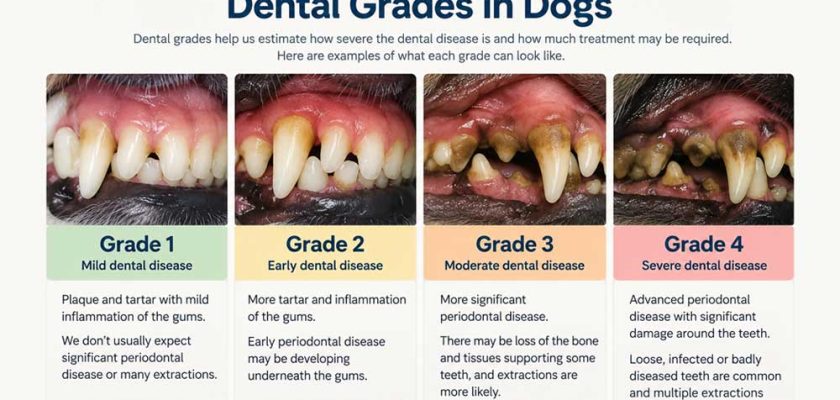
Dental grades help us estimate how severe a dog’s dental disease is, how difficult the procedure may be and ultimately give us an idea of the likely cost.
The important thing to remember is that the grade we give an awake dog is only an estimate.
Dental grades are an estimate before anaesthesia. Disease hidden below the gum line may change what we find.
What do the grades mean?
Grade 1 – Mild
Plaque and tartar with mild gum inflammation. We generally expect a straightforward clean with little or no periodontal disease.
Grade 2 – Early dental disease
More tartar and gum inflammation. Early disease may be developing below the gum line, so there is a greater chance that X-rays will find teeth needing treatment.
Grade 3 – Moderate dental disease
More significant disease below the gums, including loss of the bone and tissues supporting some teeth. Extractions are more likely.
Grade 4 – Severe dental disease
Advanced periodontal disease with significant bone loss, loose or infected teeth. Multiple extractions may be required.
Why isn’t the dental grade always accurate?
During a consultation we can see the crowns of the teeth, tartar, inflamed gums and sometimes loose teeth. But we cannot see what is happening around the roots.
A dog also will not allow us to place a dental X-ray plate inside the mouth and precisely position it around individual teeth while awake. Dental X-rays therefore need to be taken under anaesthesia.
Sometimes a mouth that looks like a Grade 1 while the dog is awake turns out to have much more significant disease once we can examine and X-ray it – occasionally closer to a Grade 3.
Think of a tooth like an iceberg
The crown is the part of the tooth we can see above the gum – like the tip of an iceberg above the water.
The root is hidden below the gum and inside the jawbone – like the much larger part of the iceberg underneath the water.
Dental X-rays allow us to look below the surface. They show the roots and the bone surrounding them, where important dental disease can be completely hidden.
How does the grade affect the price?
The higher the grade, the more treatment and time we are likely to need. A Grade 1 dental may simply require cleaning and polishing, while a Grade 3 or 4 dental may involve X-rays, extractions and considerably more anaesthetic and surgical time.
This is why dental grades are useful for estimating cost – but the final treatment and price can sometimes change once we can properly assess the mouth under anaesthesia.
Does your dog need a dental?
At Sandringham Veterinary Hospital in Bayside Melbourne, we use dental grades to give owners the best estimate we can before a dental procedure.
If you’re concerned about your dog’s teeth or bad breath, contact Sandringham Veterinary Hospital for a dental assessment.